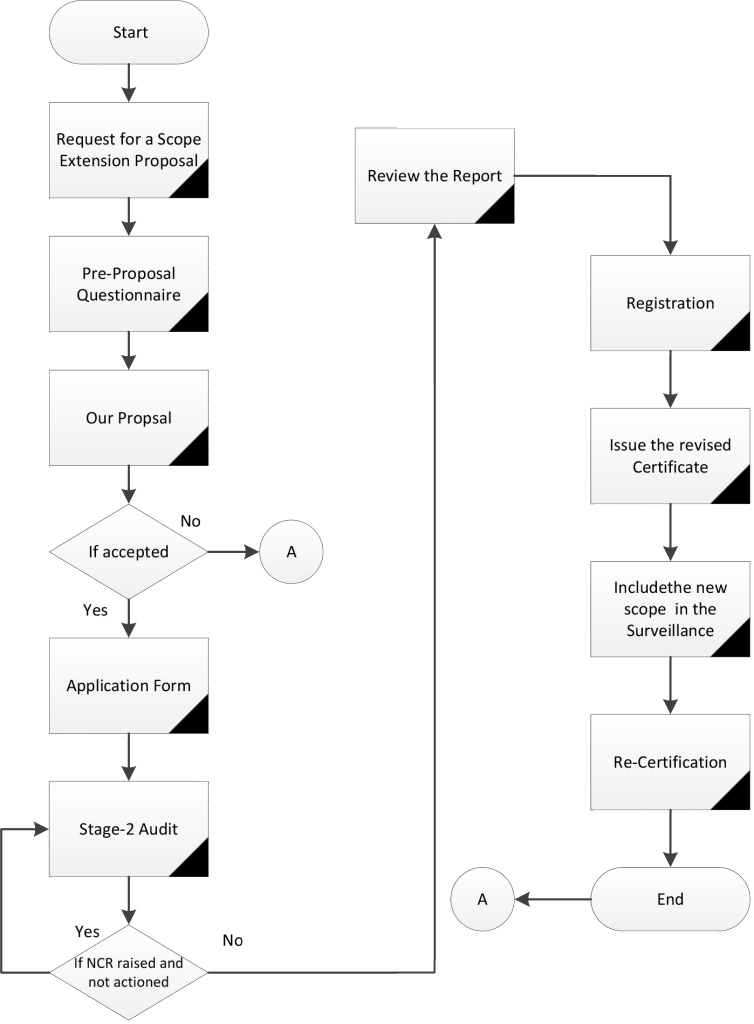
As your business grows, diversifies its offerings, or adds new operational boundaries, your certified management system can expand to reflect these changes. Business Systems Certification (BSC) provides a transparent, structured pathway to extend the scope of your existing certification without disrupting your current certification cycle.
Detailed Stage Scope Extention
1. Request for a Scope Extension Proposal
- What Happens: The certified client submits an initial request indicating their intention to expand their existing certification scope (e.g., adding a new product line, process, service, or operational location).
- Portal Action: Submit an online Scope Extension Inquiry or contact your BSC client manager directly.
2. Pre-Proposal Questionnaire
- What Happens: To understand the nature, complexity, and resource requirements of the new activities, the client completes a preliminary scoping questionnaire.
- Purpose: This enables BSC to determine auditor competence requirements, sector codes, and required audit man-days in compliance with international accreditation criteria.
3. Proposal Issuance & Evaluation
- Our Proposal: BSC issues a formal commercial and technical proposal outlining the audit duration, schedule, and applicable assessment fees.
- Decision Gate (If Accepted?):
- No (Path A): If the client decides not to proceed, the scope extension process terminates, and the client retains their original, existing certification scope without any changes.
- Yes: If the client accepts the terms, the workflow moves directly into the formal assessment phase.
4. Formal Application Submission
- What Happens: The client submits the finalized Application Form along with essential system documentation, updated process manuals, and organizational charts that detail the expanded scope.
5. On-Site Assessment (Stage-2 Audit)
- What Happens: A qualified BSC audit team conducts an on-site (or authorized remote/hybrid) Stage-2 audit focusing on the newly added processes, sites, or services.
- Evaluation Gate (If NCR Raised and Not Actioned?):
- Yes (Issues Outstanding): If non-conformity reports (NCRs) are identified and corrective action evidence has not yet been accepted or actioned by the client, the process loops back to ensure resolution before moving forward.
- No (Cleared): Once all requirements are satisfactorily met and any identified NCRs are closed out, the audit file proceeds to technical verification.
6. Technical Review of the Report
- What Happens: The completed audit report and supporting audit evidence are submitted to an independent BSC technical reviewer/certification decision committee.
- Purpose: Ensures impartial technical evaluation, compliance with accreditation rules, and formal approval for the certificate modification.
7. Registration & Revised Certificate Issuance
- Registration: The updated organizational details and extended scope are updated within the official BSC certification database and public registry.
- Issue Revised Certificate: BSC issues a newly revised certificate reflecting the extended scope, while preserving the original certification cycle expiry timeline.
8. Integration into Surveillance & Re-Certification
- Include the New Scope in Surveillance: Subsequent routine annual surveillance audits will incorporate the newly expanded scope into their regular audit sampling plan.
- Re-Certification: At the conclusion of the 3-year cycle, the complete integrated scope (original plus extensions) undergoes full recertification assessment to renew the cycle.
Key Information for Applicants
- Cycle Continuity: Extending your scope does not reset your three-year certification expiration date; your current cycle timeline remains intact.
- Audit Timing: Where feasible, a scope extension audit may be coordinated concurrently with your scheduled routine surveillance audit to optimize cost and resource efficiency.
- Inquiries & Assistance: Contact our operations team via the client portal to begin your questionnaire or request guidance on sector-specific requirements.